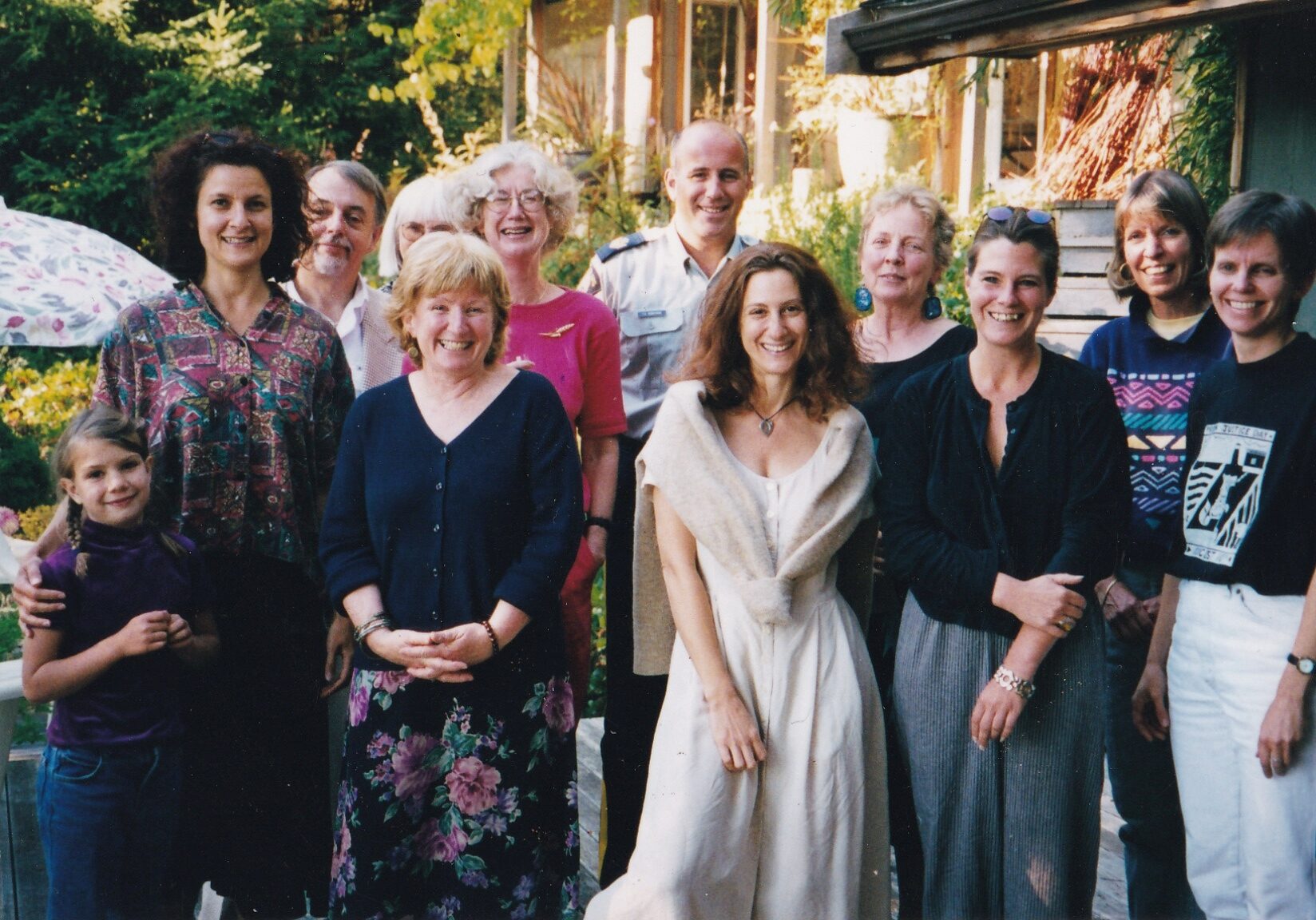
Thirty years ago, Lynda Laushway was the first executive director of SWOVA (Salt Spring Women Opposed Violence and Abuse), which became The Circle Education in 2020. Her personal set of values and background in criminal justice led her on a path of preventing gender-based violence on Salt Spring Island.
It has been nine years since Lynda Laushway retired, and since then, she has been following The Circle Education from the sidelines. For this interview, we first go back to 1992, when SWOVA was founded after a horrific incident in which a woman on Salt Spring was severely injured by an intruder in her home.
“I was, like many other islanders, shocked by this incident”, says Lynda, who moved from Newfoundland to Salt Spring Island in 1984. “A candlelight vigil was held in the park, and a lot of women showed up, deeply concerned about what had happened.”
After the vigil, a small group of women stayed connected. “We were wondering what services were available for women who were impacted by violence, and it turned out that there was nothing. No safe house or transition house, no crisis line, so we decided as a group to form a non-profit society focusing on helping women and children who are impacted by gender-based violence.”
Lynda has a bachelor’s degree in fine art, with a minor in sociology and psychology, and a master’s degree in applied criminology. “But first of all, I was a feminist with a deep concern for social justice”, she continues. “Before I moved to Salt Spring, I worked in Ottawa for the Solicitor General of Canada and as an assistant editor for a monthly publication on criminal justice. I’d travelled all across Canada and seen every major prison. It was very depressing, and I decided that if I was ever going to work in this area again, it had to be in prevention. I wanted to try to stop all this horrendous damage to people.”
SWOVA was, almost from the start, part of a new, Canada-wide, crime prevention strategy pilot project. “One of the first things we did with this federal funding was to set up an assessment of Salt Spring Island. It turned out that the number of incidents of violence against women on Salt Spring was pretty much on par with the national statistics. We might have the illusion that nothing happens in this quiet little community, but that’s not true. A small island can be isolating; it is harder to get away or disappear as you would be able to do in a big city.”
The organization grew fast in the first years. “An anonymous donor donated a house, we operated a crisis line, and we were trying to focus on prevention at the same time. After a few years, we realized that we were moving in too many directions. And that’s when we decided to split into two societies. IWAV became the service provider for abuse survivors, and SWOVA was primarily set up for research and the development of prevention programs.”
Lynda became the first executive director of SWOVA. “We focused on education and advocacy, and that is where my passion lies,” Lynda continues. There were a lot of challenges in the beginning, she recalls. “We had to regroup, making connections with people who’d fit within our mandate and find funding. It turned out that it is easier to find funding for women who need immediate help than for the prevention side. But we were lucky to get support and funds early on from the BC Ministry of Women’s Equality.”
In her years as executive director, Lynda developed a violence prevention program for men and women, the Respectful Relationships Program for students in grades 4 to 12, and started a youth facilitator team, all to help adults, adolescents, and children build healthy relationships. “Every once in a while, I run into a young person who was in our programs, telling me that the program had changed their life. Which is so great to hear.”
The ride was sometimes bumpy, she says, which happens when you start something new. “Change does not always happen smoothly. You move forward, you move back, and move forward again. A lot of people said that our plans would fail, we were sometimes threatened, but we did it, and we even received national recognition. I am proud of that. It is pretty unique what we have here. You could probably count communities as big as ours in our country that have a dedicated agency focusing on preventing violence and building healthy relationships, on two hands.”
Lynda retired in 2016. “It was time for me to turn over the reins to someone younger, and it is absolutely wonderful that The Circle Education is still going strong,” she says. “We need these programs now more than ever. We live in unpredictable times, and some very powerful people have narrow-minded ideas. It feels like we are going back fifty years in time or even more, and that concerns me greatly. My hope for the future is that The Circle Education continues to grow and flourish, and to be supported in the community to offer these valuable programs.”