
Blog

Seizing Teachable Moments to Overcome Prejudices

July 7, 2022

This is the final reflection to the Circle Education’s “Connecting the Dots”, a series to acknowledge World Day for Cultural Diversity for Dialogue and Development. Kate Nash, who leads our youth programs in School District 64, knows how important open dialogue is. Even when it feels uncomfortable.   

Imagine a school with plenty of light, plants and bright art on the walls.  It is hard for such an environment to not inspire feelings of joy, comfort and belonging. The things we see have an impact on how we feel.  You can imagine how it felt when I walked in one Monday morning and noticed small swastikas scribbled onto the vending machines.   

There are two ways to respond to such a situation; one is to remain open and curious and the other is to blame and shame.  While the latter drives people closer to their prejudices in an act of defense, curiosity cultivates conversation.

As a facilitator for The Circle Education, I deliver social-emotional programs to kids in our school district.  I connect with over 300 students every year.  Needless to say, I spend a lot of time in schools. This was the first time I encountered such an act of ignorance and disrespect. How could I stay curious?

The teacher was in the classroom when I arrived for my first session of that day, though the class was still away at gym. It was a good chance to check in. Did something come up in between sessions, in the halls, or in class?

The teacher told me about the swastikas right away and I asked her if the students mentioned it in class? She said that she wasn’t sure how to bring it up, that she didn’t want to draw attention to it, or make the students feel like she was blaming them. That day I’d planned to talk about labels and I told her that I imagined it would come up.

No matter how many times I lead a session on labels, I am always surprised by how engaged students become.  Speaking to the topic of labels seems to somehow open the gate for feelings and thoughts that might otherwise seem off-limits.  In my experience, youth want to speak about the uncomfortable things, and this makes sense as they are still learning and trying to figure out their worlds. No thanks to the internet, they are inundated with so many different perspectives, ideas and information, not all of which are true and many of which are harmful. They want to mention the unmentionable, it can just seem so hard, so confusing, to bring it up.  I have noticed that if I make space, what needs to be talked about will emerge.  I felt pretty confident that the topic of labels would be the foundation required to speak about the swastikas. I was curious to see what would bubble up.

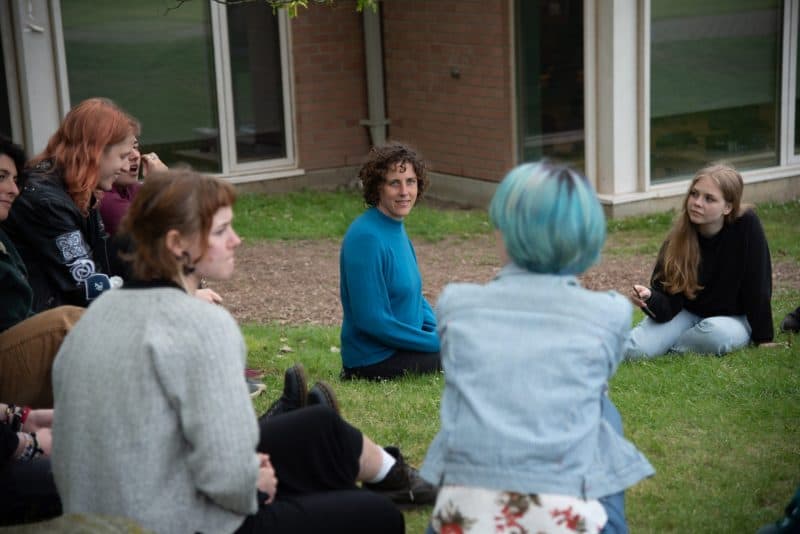
We started by gathering in a circle, and after introducing the session topic and checking in with the class, I led with curiosity. 

What are some labels that you see in your school? I asked.

At first, they mentioned directional signs, like bathroom and office signs. Then they spoke about the labels of being in French Immersion vs English.  Eventually, students mentioned the swastikas.

How does that make you feel? Why do you think someone is doing that?  

“I feel really uncomfortable seeing them. I think some kids are racist,” said one youth.

“I didn’t notice. It’s probably a joke,” said another.

“I don’t really understand it, but my friend was really upset,” said a third.

“I think that some kids will do anything for attention,” a boy said.

“And just want to be seen as, like, rebellious or something,” his friend added.

It is no wonder that we make assumptions, hurt others, have prejudices.  We each have our unique feeling about the same experience.  I think it is easy for us to assume that others see things as we do.  But when you ask a question of a group, with no right or wrong answer, suddenly the breadth of perspectives is as varied as the people in the room. 

I continued to lean in.

How could that act of rebellion actually create harm? What kind of harm was created? I asked the class.   

Fear, shame, discomfort. The students spoke to the fact that that sort of vandalism elicited a feeling of “us” and “them”. It made some people feel they were less than others, or a target, and that made coming to school feel less safe than before.  Even if it was rebellious, they didn’t feel it was okay to hurt ignorantly.  Now we were having a conversation about the impacts of our actions. 

We never did come around to who drew those swastikas. I am not sure it really matters. In this instance, I think what was more important, was to provide the space for an important “curious” conversation to occur, without finger-pointing and shame.  If the culprits of the vandalism were in that class that day, they would have seen the impact of their actions far greater than if they were suspended or had to stay after class. In having this conversation, those harmfully impacted were given the opportunity to have a voice about the impact on them, and those who created harm listened respectfully and learned.

 As someone who talks with young people all the time, I have learned how important it is to stay curious, even in situations where the context might be hurtful. This is how learning occurs. When we as mentors to our youth, show up with interest, we allow the space for youth to articulate and understand the implications of their actions/words, speak to their fears and prejudices, and explore ways to reconcile them.  What an opportunity we would have missed if we didn’t have this conversation that day.
New to Salt Spring, Devon is excited to engage with the local community. As a certified teacher and registered counsellor, she works with students both on Salt Spring and across BC, offering social and emotional instruction, support, and skill development. Her extensive experience in both educational and recreational settings has given her a strong appreciation for the critical role that meaningful connection with others plays in the development of children and youth. A strong advocate for social-emotional learning, Devon views it as the foundation for all other areas of growth and is particularly inspired by the programs offered by The Circle Education.

Need Bio

Christina Adair is a dedicated professional serving as a District Child and Youth Worker for SD64. With an extensive background spanning over 15 years, Christina has acquired substantial experience working with children and youth in diverse capacities. Her unwavering commitment lies in fostering youth leadership and advocating for their rights. Christina has demonstrated her dedication through 13 years of volunteering with Scouts Canada, where she successfully led youth groups and facilitated adult meetings. Christina takes immense pride in her role as a caregiver and mentor to countless young individuals, with her two grown children serving as a testament to her nurturing capabilities.

Dan has been working in the credit union system for over 22 years, the last 8 with Island Savings, a division of First West Credit Union.  His latest role is as a Branch Manager for the Salt Spring branch.

He has a long-time passion for giving back to his community, particularly where children are concerned.  He has been a scout leader for the last 19 years and has taken part in 2 Pacific Jamborees.  Once as a participant and the latest one as the treasurer.

He also volunteered for 12 years with the PACE program in Victoria.  PACE is a musical theater program through the school system for children ages 5 – 17 that puts on two shows every year.

While new to Salt Spring, having moved here in the spring of 2021, he is excited to get involved with the community and proud to be involved with The Circle Education.

Lisa grew up in Cochrane, Alberta, and has recently come to live on Salt Spring Island, after having lived abroad for 25 years.  She studied fine arts at the Wackers Academie in Amsterdam, had a son in Denmark and a daughter in the UK. She served as Chair of the PTA of Holy Trinity Primary School in Wimbledon for 5 years, which was a registered charity entity separate from the school. She learned about the Pass it On Boys program when her son showed an interest in joining it. Being new to the community she asked fellow parents about the program to find out how it was viewed. After hearing only good things about it, she registered her son and the next logical step was of course to join the board, as she always strives to be an active member of the community by providing support based on her broad life experience.

Lyyli Kennedy was a Pass it On mentor at Gulf Islands Secondary School and has been drawn to the idea of working with The Circle Education for a long time. She had been waiting for a facilitator role that aligned with her schedule as head baker at Francis Bread, and this role with the Pass it On Program is the perfect match. With her background leading diverse kitchen teams and working as a classroom education assistant, Lyyli (pronounced Loo-Lee) is committed to fostering respectful relationships and inclusive spaces.

Patrick Howlett moved from Australia to Canada in 2019. Nine years earlier, he switched careers from communications to outdoor education. He worked with young people at The Great Aussie Bush Camp and Camp Tanuga in Michigan, USA, and helped students run their Senior Leadership Challenge at Camp Summit in Squamish. His work with youth taught him the value of patience, the ability to see the best in people, the importance of clear communication and empathy.

Marcia is our Communications and Event Coordinator since July 2021. She moved with her husband and two daughters – who are both attending high school in SD64 now – from the Netherlands to Salt Spring Island in 2012

As a swim team coach for the Salt Spring Stingrays, Marcia knows and understands youth realities of living on a small island.

Marcia has 25+ years of experience in writing and communication for Dutch and Canadian media outlets – most recently the Driftwood – and non-for-profits.

Kate has been working with The Circle since 2010, serving as a facilitator and contributor to program development. Her extensive experience in developing and implementing curricula has supported the organization's ability to address youth needs effectively.

Kate's unique approach combines her background in theatre, play building, and improv with a deep understanding of youth development. This blend of skills allows her to create engaging, interactive experiences that resonate with young people across various age groups.

Students consistently praise Kate for her compassion, attentiveness, and ability to create a warm, welcoming atmosphere.

Nick MacKinnon has a background in cancer research and biomedical engineering and in working with medical device startup companies as a founder and director. As a former educator, Nick has a strong commitment to STEM advocacy. He has served as a director and advisor on multiple boards and advisory committees, including the biomedical engineering programs at BCIT and UBC and professional associations in both BC and internationally. Nick has also been involved with non-profit cooperatives in British Columbia, particularly in the housing and car-sharing sectors. Notably, as a director, he helped lead the development and construction of the 54-unit Arbutus Housing Co-op in Vancouver. Now retired, Nick continues his longstanding dedication to education and social justice. As a director with The Circle Education, his interest is in governance, financial management, and fundraising.

Need Bio/Last Name

Janine started her career with the Ministry of Education in Victoria, B.C. in 2000 as an education officer in the area of accountability and system performance. Since moving to SSI, Janine has taught as a teacher-on-call with School District #64, delivered parent support sessions as a trained Virtues Project Facilitator and worked for Volunteer and Community Resources Society (VCR) in support of the island’s not-for-profit sector.

Janine is a dedicated member of the Salt Spring Island community. She sat on the Board of The Lady Minto Hospital Foundation for six years, served as chair of the SSI Foundation Grants Advisory Committee for six years, coordinated the local Terry Fox Run for eight years, served as a board member and then president of the Salt Spring Island Aquatic Society for a total of eight years, and in 2018, she founded the local chapter of 100 Women Who Care.